



Historie města
There are several theories about the origin of the name Luhačovice. It is generally believed that the names of towns ending in -ice were derived from the name of the family’s founder, namely Luhač (Luhačovice). The name Luhačovice may also have been derived from the fact that there were floodplains in the vicinity of Horní Olšava.
Last update: July 17, 2026 17:02
| The Origin of the Name Luhačovice | There are several theories about the origin of the name Luhačovice. It is generally believed that the names of towns ending in -ice were derived from the name of the family’s founder, namely Luhač (Luhačovice). The name Luhačovice may also have been derived from the fact that there were floodplains in the vicinity of Horní Olšava. |
| First mention | The first traces of Slavic settlement in this region date back to the 7th and 8th centuries, as evidenced by archaeological finds in Obora near Luhačovice. For centuries, however, the region was not permanently inhabited. It was a border area plagued by numerous enemy incursions, which continued to hinder the establishment of villages and settlements in the centuries that followed. The first written record of Luhačovice dates back to 1412. However, this does not mean that Luhačovice was only just being settled at that time. The oldest historical mention related to this area pertains to Prakšice and Biskupice and dates back to 1140. These records regarding the Luhačovice region document the process of settlement, which moved from the plains toward more mountainous terrain. |
| Several villages | A structure of villages and cadastral districts took shape, which remained largely unchanged until the mid-19th century. The local villages suffered greatly from enemy incursions. Moreover, in the mid-15th century, this estate was owned by the Hungarian magnate Pankrác of St. Nicholas, the infamous leader of bandits who ravaged the entire region. The main sources of livelihood in the hilly Luhačovice region were cattle ranching and fruit growing, as evidenced by the seal—a spreading tree with apples, a pruning shears on the right, and a plowshare on the left. |
| The Family Estate and the First Source | In 1590, Luhačovice belonged to the Bartoděj family of Bartoděj. After the Battle of White Mountain, the estate was confiscated and acquired by Maximilian of Liechtenstein. He sold it in 1629 to Gabriel Serenyi, and it remained in his family until 1945. This family played an extraordinary role in the town’s subsequent development. The Serenyi family recognized the importance of the healing waters and their potential for business. Count Ondřej Serenyi had a spring at the northern foot of Malá Kamenná, which bubbled loudly as it rose to the surface and was called “Bublavý,” developed. At the end of the 18th century, it was renamed and given a name derived from the first name of a male member of the noble family. In this case, it was Amanda Serenyi, and so the spring was named Amandka. |
| The Discovery of the Springs | Around 1860, another spring was developed. Originally named “Hlavní” (Main), it was later renamed “Vincentka” after Count Vincent Serenyi. News of the healing powers of Luhačovice’s waters spread throughout the region, and the first guests began to arrive at the springs. There was no accommodation available for the several-day stays required to achieve a therapeutic effect, nor were there dining facilities or medical facilities. |
Gradually, however, interest in the local springs grew, and in 1789 the then-owner of the Luhačovice estate had an inn built near the springs, complete with several rooms to accommodate guests. The spa’s growth was fueled by reports of successful treatments and numerous medical papers that highly praised the beneficial healing properties of “Luhačovice water.” These positive expert evaluations led to increased exports of the local mineral water and contributed to the growing number of patients receiving treatment.
Boom
Toward the end of the 18th century, construction activity around the springs intensified considerably. The Small Castle, Vincenc’s House, the Carpenter’s House, the Country House, and other buildings with guest rooms were constructed. In 1795, the Chapel of St. Elizabeth was built, with the coat of arms of the Serenyi count family depicted on its facade. The ringing of the bell in its turret signaled the beginning and end of the treatment day. The chapel still stands today and is the oldest building in the spa town.
In the mid-19th century, the spa had 10 named buildings with 83 rooms, two kitchen buildings, and two squares—the Main Square and Josef Square. In 1895, the spa recorded its highest number of guests to date—as many as 1,700. However, it was precisely in this year that previously hidden conflicts came to light. Spa guests complained about the dilapidated interiors of the spa buildings and treatment facilities. They demanded greater comfort, as even basic amenities were lacking in many places.
Spa Corporation
By the end of the 19th century, the Luhačovice spa was facing stagnation and the threat of decline. The spa’s transformation into a joint-stock company in 1902 marked a significant milestone for Luhačovice. The Újezdec u Luhačovic–Luhačovice railway line was built, which became essential for the town; direct trains from Prague, Brno, and Olomouc began running to Luhačovice in 1905.
In early 1902, the founding meeting of the joint-stock company was held; Count Otto Serenyi was elected chairman of the board of directors; Dr. František Veselý became the spa director and the driving force behind the establishment of the joint-stock company; and Cyril Holuby, a Slovak, was appointed its administrator. They all strove to ensure the spa’s maximum development, modern facilities, and a high standard of medical care; they devoted exceptional attention to the mineral springs and recognized the importance of a rich and vibrant cultural and social life in the town.
Manuscript by Dušan Jurkovič
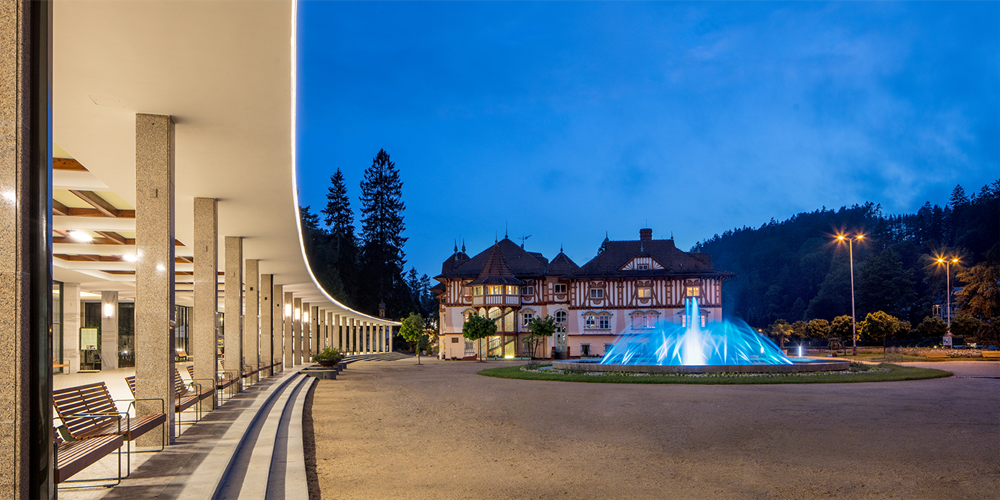
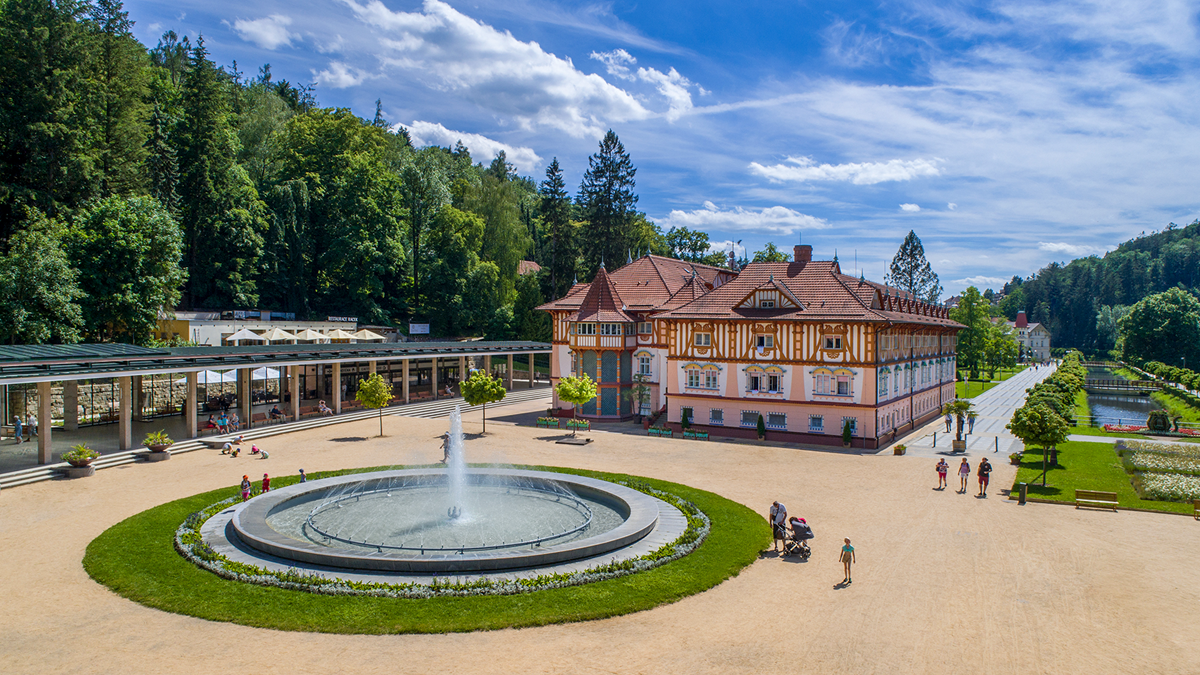
Together with them, architect Dušan Jurkovič brought to life the dream of a modern and comfortable spa. His work is the result of his efforts to understand the environment in which he lived, to recognize and preserve its values, and to understand the people for whom he created. We can still admire his sensitivity to the environment and his understanding of the place today when touring Jurkovič’s (formerly Jan’s) house on Lázeňské náměstí, the nearby Chaloupka, which has been beautifully restored, or in the charming Sluneční Lázně, the Jestřabí building, and the Hydrotherapy Institute. All of these structures stand as a testament to the greatness of Dušan Jurkovič’s art, but they also demonstrate the extraordinary nature of the environment that inspired their creator.
The Spa Theater and Development During the First Republic
However, the joint-stock company’s financial resources were insufficient to build a proper cultural venue. The Cooperative for the Construction of the Spa Theater took on this task. The distinguished spa physician Dr. Zikmund Janke became the initiator and enthusiastic organizer of the entire project. The theater began operations in 1908, though it faced significant difficulties and was burdened by debt. Nevertheless, the construction of the theater building was a major contribution to the cultural life of the spa town.
Following a period of stagnation after the war, the establishment of Czechoslovakia marked the beginning of a new era of development for Luhačovice. In 1922, construction of the municipal office and the town school was completed near the train station. Renowned architects contributed to the development of Luhačovice, imbuing the town with a distinctive charm and a unique character. Architect Bohuslav Fuchs contributed to the construction of the White Quarter; architect J. L. Holzl designed the Arco Hotel (today the Morava Spa House); and the Kub brothers contributed to the design of the Sokol Hall, which was completed in 1930, among other projects.
Luhačovice Is Becoming a City
In 1928, the dam above Luhačovice was completed and filled with water. In 1931, the town was electrified. The appearance of the spa complex changed radically in 1934 with the construction of the Community Center, designed by architect J. Roith. Despite extensive construction, a growing population, and the ongoing modernization of the town, it took nearly six years from the submission of the application to the government before Luhačovice was granted city status. This occurred on July 3, 1936. From the moment the application for city status was submitted, the Luhačovice municipality worked to ensure that Luhačovice would take on the character of a city, including in its appearance.
A new landmark in the city center—the savings bank building—was constructed and officially opened on August 15, 1937; today it houses the city hall. In the 1930s, Luhačovice had police authority; it was also a town of small business owners whose trades were entirely dependent on the spa and seasonal nature of the town, and it had an elementary school, a high school, and a kindergarten.
World War II
After 1930, the hall of the new Sokol gymnasium became the main venue for cultural events, and from 1935 onward, it was primarily the Community Center on the spa grounds, which was also used extensively outside the spa season. This burgeoning social and cultural life was disrupted by World War II and the occupation. Luhačovice was occupied on March 16, 1939. In May 1941, the town’s Jewish residents were deported to Terezín; most of them never returned. The same fate befell the Roma of Luhačovice. Guesthouses, villas, and hotels—including the school building—were used to house German youth.
Postwar Development and Modernization
The liberation on May 2, 1945, marked the beginning of a new phase in the development of the Luhačovice spa. The spa’s management secured the project documentation and set out to create a grand design for the spa square. The Grand Colonnade, with its striking arched floor plan, follows the base of Velká Kamenná Hill and is lightened by glass walls that offer views of the surrounding greenery. The massive volume of the Vincentka Hall is softened by the horizontal lines of the Small Colonnade and the polyclinic. As a result, the Luhačovice Spa gained not only the necessary functional spaces but also significant panoramic landmarks that, together with Jurkovič House, create the distinctive character of the place. Well-maintained and decorated parks, statues, and fountains are an integral part of the spa environment.
The most famous fountain in Luhačovice was created by Jan Kavan; it was brought here from the EXPO 58 World’s Fair in Brussels, which is why it is called the Brussels Fountain. The Round Fountain is located on Spa Square. The newest fountain in Luhačovice is part of the landmark roundabout built in 2000 on 28 October Square. The mineral springs are the most valuable and irreplaceable treasure of this spa town. They have been the focus of much attention since time immemorial, and care for the mineral springs has never been interrupted.
Hydrogeological surveys have confirmed the existence of additional, relatively abundant sources of medicinal water and have disproved the mistaken assumption that the capacities of individual springs negatively affect one another. In 2000, Luhačovice’s newest spring, St. Joseph’s Spring, was ceremonially consecrated near the Church of the Holy Family.
For a more in-depth look at the history of Luhačovice, we recommend visiting the StareLuhacovice.cz website, where you’ll find a wealth of information and, if applicable, services related to our town’s historical heritage.
Related Articles
- Antonín Václavík and His "Zálesí" in Luhačovice—a book that captures a vanishing world
- Architecture
- The History of Spa Tourism in Luhačovice
- The Oldest Residents of Luhačovice—From Prehistory to the First Civil Registers
- Surnames That Have Lived Here for Centuries—Luhačovice Families from the Parish Registers


Our partners





The server is operated by © ZLIN.CZ s.r.o.