Famous People of Luhačovice
Luhačovice is not just a spa town—it is a living story of the people who have shaped its unique character. From the architect who transformed this provincial town into an Art Nouveau gem, to the brilliant composer who experienced passionate romances here, to the visionary doctor without whom today’s spa would look completely different. Let’s take a look at the lives of the figures without whom Luhačovice would not be Luhačovice.
Dušan Jurkovič — the architect who gave Luhačovice its character
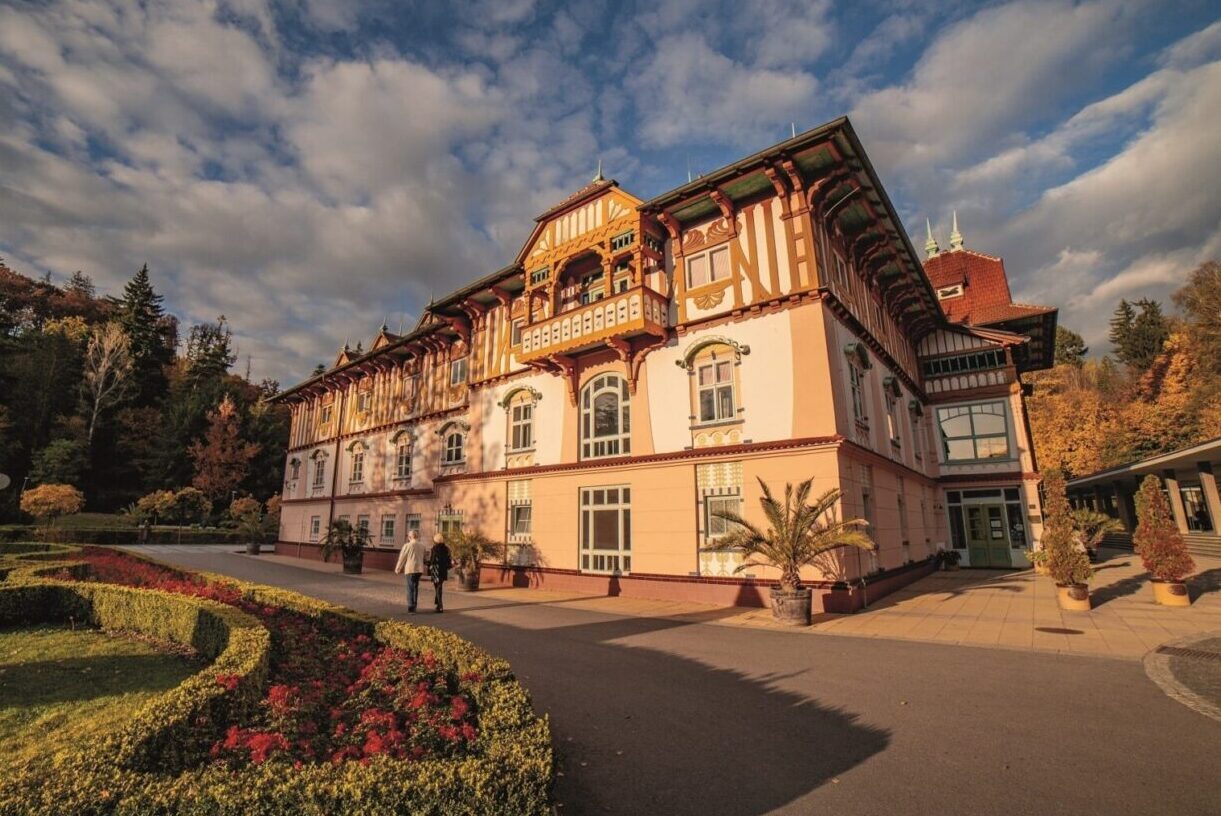
When the Slovak architect Dušan Samo Jurkovič (1868–1947) arrived in Luhačovice in 1902, he found a nondescript spa town with a few old buildings. In just two years, he transformed it into a unique architectural ensemble unparalleled in Europe. His style—a blend of folk architecture from the Moravian-Slovak border region and Viennese Art Nouveau—gave Luhačovice the character it retains to this day.
Jurkovič’s first major project was the renovation of two old buildings into Janův dům (today Jurkovičův dům), where he masterfully combined sun-dried clay bricks with modern concrete pillars and adorned the entire structure with colorful murals. In the same year, he converted the former kitchen house into the charming Chaloupka villa, where the stone ground floor transitions into a wooden log upper floor with balconies. In 1903, new buildings were added: the Jestřabí villa, the Vlastimil villa, and the spa restaurant, as well as a swimming pool complex with an entrance building and the Hydrotherapy building.
In total, Jurkovič built twelve buildings in the folk Art Nouveau style in Luhačovice. Eight of them have survived to the present day and form the core of the spa center—all are cultural monuments. Jurkovič also worked on the overall urban design of the spa and, between 1907 and 1914, submitted further bold proposals, including a colonnade and a reading room, which, however, were never realized. Nevertheless, his legacy is indelible: Luhačovice is, without exaggeration, his life’s work, where he succeeded in what he had dreamed of—merging modern architecture with the spirit of folk tradition.
Leoš Janáček — a musical genius inspired by the spa
No figure is as deeply connected to Luhačovice as the composer Leoš Janáček (1854–1928). He first came here in 1886 and returned almost every summer starting in 1903—more than twenty times in total. He spent a total of sixty weeks of his life in Luhačovice. For him, it was not merely a place of healing and rest, but above all a source of creative inspiration and the setting for fateful encounters.
It was in August 1903 that a scene straight out of a novel unfolded. In the spa restaurant designed by Jurkovič, an unknown woman appeared before Janáček, placed three roses before him, and vanished. She was Kamila Urválková, the beautiful and spirited wife of the forest councilor. Janáček was enchanted. He decided to compose an opera for her that would clear her of slander—thus Osud was born, whose first act symbolically takes place on the Luhačovice colonnade. The name of the main heroine, Míla Válková, strikingly resembles Kamila Urválková. The opera did not premiere until 1958, thirty years after the composer’s death.
But Luhačovice had another, far more intense encounter in store for Janáček. In July 1917, he met twenty-five-year-old Kamila Stösslová in the spa park—and fell completely head over heels. He was sixty-three years old and she was married, yet over the next eleven years he wrote her over 700 letters. Kamila became his muse: she inspired the characters of Káťa Kabanová and Emilie Marty in Makropulos, and he dedicated his String Quartet No. 2 to her, aptly titled Intimate Letters. It was also in Luhačovice that he composed most of the Glagolitic Mass and the sketches for the opera The Cunning Little Vixen. Moreover, the Luhačovice Zálesí region served as a rich source for his collection of folk songs.
In his book *Janáček and Luhačovice*, Vladimír Vokurka captured his relationship with the spa town: “Janáček’s relationship with Luhačovice was intimate, sincere, and enduring. Every year he returned to his spa town to let himself be carried away by the whimsical, multifaceted, and carefree life there, where his insatiable sensory perception found satisfaction, comfort, and at the same time a whole range of creative ideas and inspirations.” In his honor, the Janáček and Luhačovice Music Festival is held annually, celebrating its 30th anniversary in 2023.
T. G. Masaryk and Other Presidents in Luhačovice
The founder of Czechoslovakia, Tomáš Garrigue Masaryk (1850–1937), had a deep connection to Moravia—he was born in nearby Hodonín. He enjoyed visiting Luhačovice and grew fond of the local mineral springs, especially the famous Vincentka. His visits lent prestige to the spa town and drew the attention of the entire republic. The main street in Luhačovice still bears the name Masarykova—a lasting reminder of the first president’s connection to this town.
Masaryk was not the only president to visit Luhačovice. The spa town continued to attract statesmen in later periods as well—for example, Livia Klausová served as the patron of the 22nd Janáček and Luhačovice Festival. The tradition of presidential visits confirms Luhačovice’s exceptional standing among Czech spa towns.
Dr. František Veselý — Founder of Modern Spa Medicine
Without Dr. František Veselý (1862–1923), Luhačovice would look completely different today. This native of Bystřice nad Pernštejnem, originally destined for a career in the priesthood, became a physician and humanist with a visionary mindset. When he first visited Luhačovice in 1898, he immediately recognized the potential of the healing springs and the healthy environment at the foot of the White Carpathians.
In 1902, Veselý pulled off a daring feat: a new joint-stock company purchased the spa from Count Serényi, and the forty-year-old doctor was entrusted with its administration and technical management. It was he who brought architect Jurkovič to Luhačovice. Together, they transformed the outdated baths into a modern spa complex—Veselý oversaw the renovation of buildings, the construction of new facilities, the tapping of springs, and the establishment of a mineral water bottling plant and an inhalatorium. He introduced a modern spa regimen and promoted Luhačovice through lectures, articles, and promotional materials both at home and abroad.
Veselý led the spa until 1909, when he was forced to leave his unfinished work behind. He died in Prague in 1923. Writer František Kožík immortalized his story in the novel *The Magician from the Villa Under the Linden Trees*, which aptly captures the personality of this founder, without whom Luhačovice would have remained an insignificant town on the outskirts.
Other notable figures associated with Luhačovice
Luhačovice attracted creative personalities like a magnet. Writer, playwright, and journalist Karel Čapek, author of War with the Newts and R.U.R., visited Luhačovice with his wife, who was undergoing spa treatment there. The poet Jiří Wolker, author of the collections *Host do domu* and *Těžká hodina*, sought relief from health problems in the Moravian spas—problems that ultimately led to his untimely death.
The novelist František Kožík (1909–1997) had an exceptionally strong connection to Luhačovice. He visited the spa regularly, receiving treatment, resting, and writing there. In the spa archives, he found material for his novel *Po zarostlém chodníčku* (*Along the Overgrown Path*) about Leoš Janáček, and his book *Město šťastných lásek* (*The City of Happy Loves*) was set in the swimming pool area. He also imbued the lyrics of Blahoslav Smišovský’s songs with his love for this region.
Other composers and musicians who enjoyed visiting the spa included Otakar Ostrčil, Josef Suk, the Slovak tenor Janko Blaho, and the sopranos Libuše Domanínská and Sylvie Kodetová. Actor and comedian Vlasta Burian, the most famous Czech comedian of the interwar era, spent the summer months in Luhačovice and even worked as a coach on the local tennis courts. Actors Jan Werich, Oldřich Nový, and actress Nataša Gollová also visited the spa.
The pleasant natural surroundings and unique atmosphere inspired many artists. Some settled in Luhačovice permanently—the impressionist František Pečinka, the graphic artist Jiří Pacák, and the photographer Otto Otmar. Luhačovice is also inextricably linked to the work of painters Antonín Slavíček and Joža Úprka, who captured the magic of the local landscape on their canvases.
Famous natives of Luhačovice and the surrounding area
One of the region’s most significant natives was the ethnographer Antonín Václavík (1891–1959), author of the monumental ethnographic monograph *Luhačovické Zálesí*, published in 1930. Václavík systematically documented the region’s folk architecture, customs, and traditions and compiled a unique collection of documentary photographs of buildings in the Luhačovice Zálesí, whose value continues to grow to this day.
The spiritual administrator and historian Fr. František Müller (1910–1985), a tireless collector of myths and legends, also had a deep connection to the region. From 1944 to 1985, he served at the pilgrimage site of Provodov and focused his literary work, among other things, on the Luhačovice Zálesí region, where he saved valuable fragments of folk culture from oblivion.
Since 2014, the relationship between famous figures and Luhačovice has also been commemorated by a pedestrian zone featuring bronze statues, where passersby encounter life-size figures of historical personalities. It is a fitting symbol of how naturally great stories intertwine with the everyday life of this exceptional spa town. Luhačovice not only provided famous people with a place for healing and rest—it also inspired them to create works that endure to this day.